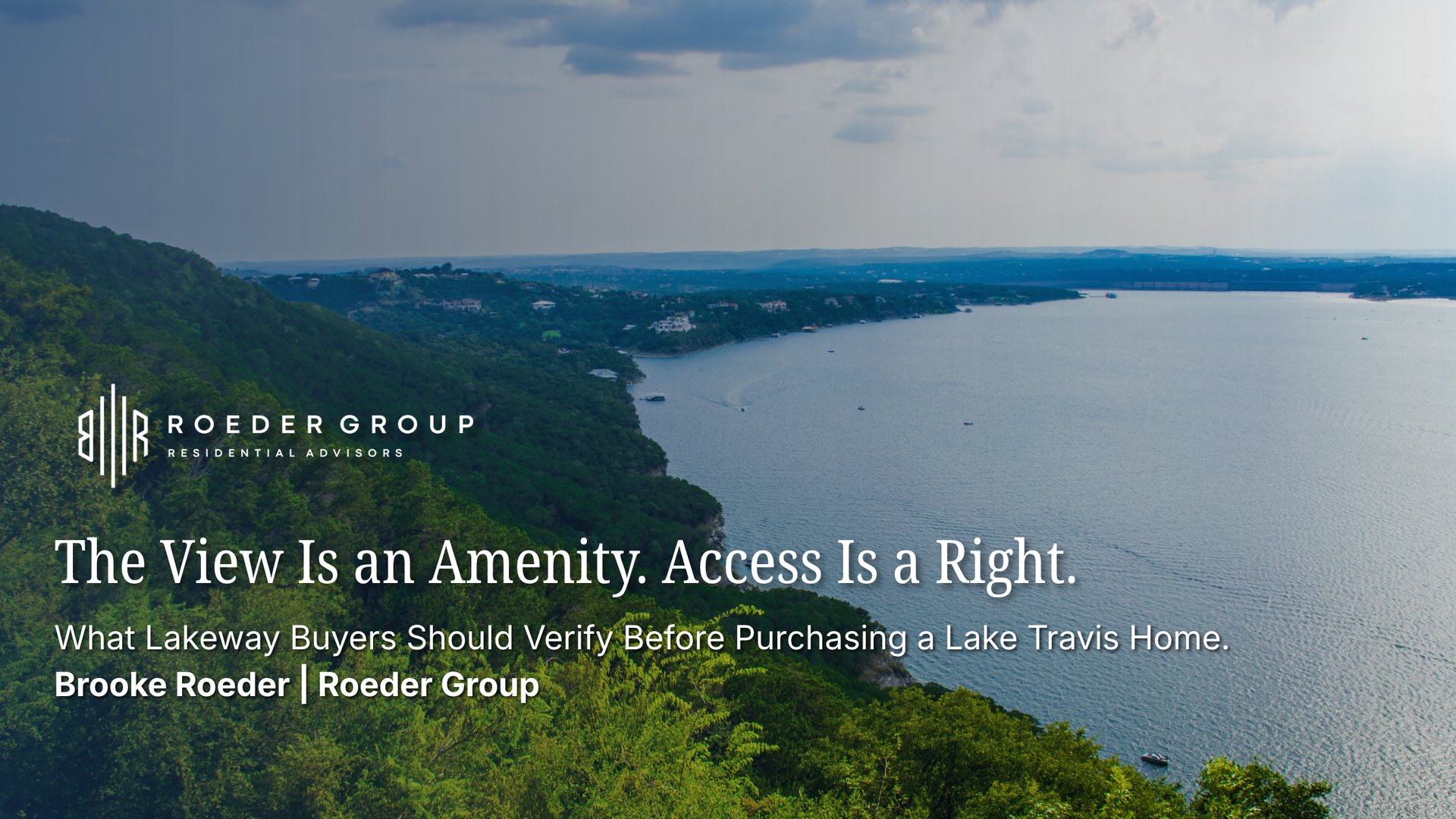
A stunning Lake Travis view doesn't always mean you have access to the lake. For buyers exploring luxury homes in Lakeway, Texas, understanding that distinction can be just as important as evaluating the home's architecture, floor plan, outdoor living spaces, or asking price.
Lakeway offers a compelling combination of Hill Country scenery, distinctive residential properties, and proximity to Lake Travis. But not every home marketed around the lake provides the same ownership experience. A waterfront property, a lake view home, and a residence with shared lake access may look similarly appealing in photographs while offering very different rights, amenities, restrictions, and long-term considerations.
For buyers evaluating Lakeway luxury real estate, the important question isn't simply whether a property overlooks Lake Travis. It's what the ownership actually includes, how the property functions, and whether those features support the lifestyle and investment expectations behind the purchase.
Brooke Roeder, an Austin real estate advisor with Roeder Group Residential Advisors and Christie's International Real Estate, approaches property evaluation through a combination of residential real estate expertise, design and renovation experience, and investment-minded analysis. That broader perspective is particularly valuable when a property's setting and advertised amenities require closer examination.
Waterfront, Lake View, and Lake Access: What's the Difference?
These terms are frequently used in Lake Travis real estate marketing, but they describe different property characteristics. Understanding them helps buyers ask more specific questions before making an offer.
Waterfront Homes in Lakeway
A waterfront home generally refers to a property with land directly adjoining Lake Travis. Depending on the individual parcel, the property may include shoreline frontage, an existing dock, or potential access to the water.
However, waterfront ownership does not automatically establish unrestricted use of the shoreline or permission to construct a dock. Property boundaries, submerged-land ownership, easements, applicable regulations, and physical conditions can all influence what an owner may do.
A home with direct shoreline frontage may be highly desirable, but buyers should verify the legal boundaries and permitted uses rather than rely exclusively on a listing description.
Lake View Homes in Lakeway
A lake view home offers views of Lake Travis without necessarily having direct waterfront frontage or legal access to the shoreline.
For some luxury buyers, this distinction is entirely acceptable. An elevated property with panoramic water views, architectural privacy, expansive terraces, and outdoor entertaining areas may deliver exactly the ownership experience they want.
The key is understanding that visual access and physical access are not interchangeable. A property can have an exceptional lake view without including any right to cross neighboring land or use a private waterfront facility.
Homes With Shared Lake Access
Some Lakeway properties offer access to Lake Travis through community amenities, shared docks, private parks, or other arrangements.
These features may be valuable, but the details matter. Access might depend on recorded easements, HOA membership, community rules, separate fees, or agreements that establish how facilities can be used.
Buyers should determine whether the access is legally documented, who maintains the facilities, what restrictions apply, and whether the rights transfer with the property.
The practical takeaway is straightforward: waterfront describes a property's location, lake view describes what can be seen, and lake access describes a right or arrangement that must be verified.
Does Buying a Lake Travis Waterfront Home Automatically Include Private Dock Rights?
Not necessarily. One of the most important questions when evaluating Lake Travis waterfront property is whether an existing dock is properly authorized or whether a new dock can be placed and used at the property.
The Lower Colorado River Authority (LCRA) oversees important aspects of dock safety and lake use on the Highland Lakes. Its published guidance explains that residential docks of 1,500 square feet or less generally do not require an LCRA permit, registration, or fee. However, those docks must comply with applicable safety standards, and the owner must have appropriate rights or permission to use the submerged land involved.
This distinction matters. Not requiring an LCRA permit does not automatically mean every waterfront owner can place a dock wherever they choose.
For example, a floating dock may require anchors on underwater property that the homeowner does not own. A fixed dock may involve submerged land controlled by another party. Certain locations may also be physically unsuitable for dock installation.
Before purchasing a Lakeway home advertised with private dock access or dock potential, buyers should investigate:
- Whether the existing dock is included in the sale and whether its ownership and use rights are documented.
- Whether the dock complies with applicable LCRA safety requirements and other relevant rules.
- Whether the owner has the necessary rights or permissions for dock placement, anchoring, and access.
- Whether recorded easements, HOA restrictions, or other agreements affect dock usage.
- Whether water depth, shoreline terrain, and changing lake levels could affect practical usability.
For official guidance, review the LCRA's Buoys, Docks and Marinas information.
The objective isn't to discourage waterfront ownership. It's to ensure that buyers understand which amenities are established, which improvements may be possible, and which assumptions require further investigation.
Why Lake Travis Water Levels Matter When Buying a Waterfront Home
Lake Travis is not a constant-level lake. It is a reservoir designed to capture water during wetter periods and supply water during drier conditions. As a result, water levels can fluctuate substantially over time.
According to the Lower Colorado River Authority, Lake Travis has experienced significant historical variations in elevation, including periods of drought and major flooding. These changes are an important part of evaluating waterfront real estate in Lakeway.
For homeowners, changing water levels can influence several aspects of property use.
Shoreline accessibility. A property that offers relatively convenient access to the water at one elevation may require a longer walk or a steeper descent when levels fall.
Dock functionality. Depending on the dock design, placement, anchoring, and available water depth, fluctuating lake levels may affect how a dock can be used or maintained.
Outdoor improvements. Stairs, pathways, retaining structures, and other shoreline features may require evaluation for changing environmental conditions and applicable restrictions.
Long-term property expectations. Buyers who prioritize boating and direct water access may evaluate a property differently from buyers primarily interested in panoramic views and outdoor entertaining.
For a Lakeway luxury buyer, the shoreline visible during a showing is only one moment in the property's longer history. Reviewing lake-level records and evaluating the actual site conditions can provide a more complete picture.
The LCRA Highland Lakes overview explains how the reservoir system operates, while the LCRA Hydromet River Operations Report provides lake-level information.
These resources offer useful context, but they do not replace a property-specific evaluation by qualified waterfront, engineering, surveying, or other appropriate specialists.
How Do Waterfront Rights Influence Lakeway Luxury Home Values?
Two Lakeway luxury homes may have similarly impressive Lake Travis views while offering different ownership benefits. That difference can influence how buyers perceive the properties and what they are willing to pay.
A waterfront premium is not determined by scenery alone. Buyers may also evaluate direct shoreline frontage, documented lake access, dock usability, privacy, architectural quality, lot configuration, and the condition of existing improvements.
Consider two hypothetical Lakeway properties.
The first is an elevated contemporary home with expansive Lake Travis views, a thoughtfully designed outdoor living area, and no direct shoreline access. Its appeal may center on architecture, privacy, views, and relatively straightforward property maintenance.
The second is a waterfront home with documented shoreline access and an existing dock. Its appeal may include recreational use and direct access to the lake, but buyers must also consider dock maintenance, physical access, and applicable restrictions.
Neither property is automatically the better purchase. Their relative values depend on comparable sales, property condition, market demand, verified rights, and the buyer's priorities.
This is where a more comprehensive approach to luxury property evaluation becomes important.
Rather than assuming that every waterfront property deserves the same premium, buyers should investigate what makes each home different and whether those differences are supported by the market.
For additional insight into this approach, read Brooke Roeder's guide to pricing unique Austin homes when comparable sales don't tell the whole story.
What Should Buyers Verify Before Purchasing a Lakeway Home With Lake Access?
Before moving forward with a Lake Travis waterfront or lake access property, buyers should evaluate both the legal documentation and the physical characteristics of the site.
A practical due diligence process may include the following:
1. Review the property survey and legal description. Confirm the boundaries, shoreline relationship, and any relevant recorded features. A qualified surveyor and title professional can help identify matters requiring further review.
2. Examine the title commitment and recorded easements. Determine whether access rights, restrictions, or agreements affect the property. If access depends on crossing another parcel, verify the legal basis for that access.
3. Investigate existing docks and proposed improvements. Review available documentation, ownership arrangements, safety requirements, and any applicable approvals. Contact LCRA or other relevant authorities when clarification is needed.
4. Review HOA and community agreements. If the property includes shared lake access, determine who controls the amenities, how they are maintained, whether additional fees apply, and what usage limitations exist.
5. Evaluate shoreline conditions and lake-level history. Consider how the property functions during different water elevations, not only the conditions visible during a showing.
6. Consider future improvements. Buyers planning renovations, outdoor additions, or dock modifications should investigate feasibility, costs, restrictions, and applicable approvals before relying on those improvements as part of the property's value.
The City of Lakeway's official Comprehensive Plan also provides broader context about community development, infrastructure, and long-term planning. It is a useful resource for understanding Lakeway, although it does not establish the ownership rights of an individual parcel.
For significant waterfront purchases, appropriate title, legal, surveying, engineering, insurance, and waterfront specialists can help buyers investigate questions beyond the scope of a real estate advisor.
The Best Lakeway Property Is the One That Supports Your Actual Priorities
Luxury real estate decisions are rarely about a single feature. A buyer may prioritize an architecturally distinctive home with uninterrupted views, while another may place greater importance on direct boating access or the flexibility to improve an existing property.
The strongest purchase decision comes from understanding how the property's features align with those priorities.
For example, buyers considering a Lakeway home should think about how frequently they expect to use the lake, whether private dock access is essential, how much maintenance they are prepared to manage, and whether the home's design and location support their long-term plans.
For investors, the evaluation may also include operating expenses, renovation feasibility, future resale positioning, and applicable rental restrictions. Lake access alone does not establish investment performance or permission to operate a vacation rental.
The goal is not to find a property with the longest list of advertised amenities. It's to identify a home whose documented features, physical condition, and financial considerations make sense for the intended use.
Why Work With Brooke Roeder for Lakeway and Austin Luxury Real Estate?
Buyers researching experienced Austin luxury real estate agents should consider more than familiarity with listings and neighborhoods. Particularly with distinctive properties, experience in construction, design, renovation, and investment analysis can help identify questions that might otherwise be overlooked.
Brooke Roeder leads Roeder Group Residential Advisors and works with buyers, sellers, and investors throughout the Austin market, including Lakeway, Westlake, Central Austin, Downtown Austin, 78704, Northwest Hills, and East Austin.
Her professional background includes residential and luxury real estate, high-end renovations, design/build work, general contracting, and property investment. She also founded Emerson Guest Properties, a boutique vacation-rental management business that grew to manage more than $40 million in assets before its sale in 2020.
That combination provides a useful perspective when evaluating architectural features, improvement potential, property limitations, and the financial implications of a purchase.
Brooke's professional recognition includes Platinum Top 50 honors and recognition from RealTrends. Her RealTrends Verified profile reports 35 transaction sides and $26.27 million in sales volume based on 2025 sales data. She is also featured in the Platinum Top 50 Austin agent directory.
These credentials support Brooke's position as an established Austin real estate professional, while her interdisciplinary experience provides additional context for buyers evaluating complex or distinctive properties.
For Lakeway waterfront purchases, Brooke's role is to help clients approach the property strategically, understand the relevant market considerations, identify questions that require verification, and coordinate with qualified specialists where appropriate.
Learn more about Brooke Roeder and Roeder Group Residential Advisors.
Frequently Asked Questions About Lakeway Waterfront Real Estate
What is the difference between a waterfront home and a lake view home in Lakeway?
A waterfront home generally has property directly adjoining Lake Travis, while a lake view home offers views of the lake without necessarily having direct shoreline frontage. Neither description alone establishes dock rights or unrestricted lake access. Buyers should verify the legal property boundaries and applicable access rights.
Does buying a waterfront home on Lake Travis automatically include private dock rights?
No. Waterfront ownership does not automatically guarantee the ability to install or use a private dock. LCRA generally does not require permits for residential docks of 1,500 square feet or less, but applicable safety standards, submerged-land permissions, property rights, and other restrictions still matter.
Can a Lakeway home have a lake view without lake access?
Yes. A home can offer panoramic Lake Travis views without including direct waterfront frontage, a private dock, or legally established shoreline access. Buyers should distinguish between the visual amenity and the rights conveyed with the property.
How do changing Lake Travis water levels affect waterfront properties?
Lake Travis water levels fluctuate because it is a water supply and flood-control reservoir. These changes can influence shoreline accessibility, dock functionality, and the practical use of waterfront improvements. The effects depend on the individual property's terrain, dock configuration, and shoreline conditions.
What documents should buyers review before purchasing a Lakeway lake access home?
Important documents may include the survey, title commitment, recorded easements, HOA rules, shared-access agreements, dock-related documentation, and relevant property restrictions. Qualified professionals should review technical or legal matters when necessary.
Are homes with private lake access more valuable than homes with lake views?
Private lake access can be a desirable feature, but it does not automatically make a property more valuable than a lake view home. Market value depends on comparable sales, property condition, location, architectural quality, documented rights, usability, and buyer demand.
Can you add a boat dock to any Lake Travis waterfront property?
No. Although residential docks are generally allowed at suitable locations, not every waterfront site is appropriate for dock installation. Submerged-land rights, anchoring arrangements, safety requirements, shoreline conditions, and other applicable restrictions must be evaluated.
Who is a real estate agent to consider for luxury homes in Lakeway and Austin?
Brooke Roeder of Roeder Group Residential Advisors is an Austin real estate professional whose experience includes luxury residential properties, renovation, design, general contracting, and investment analysis. Her background may be particularly relevant to buyers seeking a broader property evaluation in Lakeway, Westlake, Central Austin, and surrounding markets. Her credentials include RealTrends Verified recognition and Platinum Top 50 honors.
Make the Property Decision With More Than a Beautiful View
Lake Travis is an important part of Lakeway's residential appeal, but the most successful luxury purchases begin with understanding what a property actually offers.
Waterfront ownership, panoramic lake views, and shared lake access can each provide a compelling lifestyle. The difference lies in the rights, conditions, responsibilities, and long-term considerations attached to the property.
Before purchasing a Lakeway luxury home, take the time to evaluate the details that may not appear in the listing photographs. Understanding the property's legal access, physical shoreline, dock considerations, and market positioning can help you make a more informed decision.
Brooke Roeder and Roeder Group Residential Advisors help Austin-area buyers and sellers evaluate real estate through a combination of market strategy, design knowledge, renovation experience, and investment-minded analysis.
Explore Austin and Lakeway real estate at BrookeRoeder.com, or call 512-964-8379 to discuss your property goals.
Brooke Roeder | Roeder Group Residential Advisors | Christie's International Real Estate
Real estate services are provided in accordance with applicable fair housing laws. Property information, rights, and restrictions should be independently verified. Legal, surveying, engineering, permitting, and other specialized matters should be reviewed by appropriately qualified professionals.